ZINE LOCAL2025
Finding Warsaw events by vibe, not keywords
An AI-powered “vibe-based” event discovery tool for Warsaw. Instead of keyword search, users describe how they feel — “tired but curious”, “social and artsy” — and receive thoughtfully curated cultural recommendations.
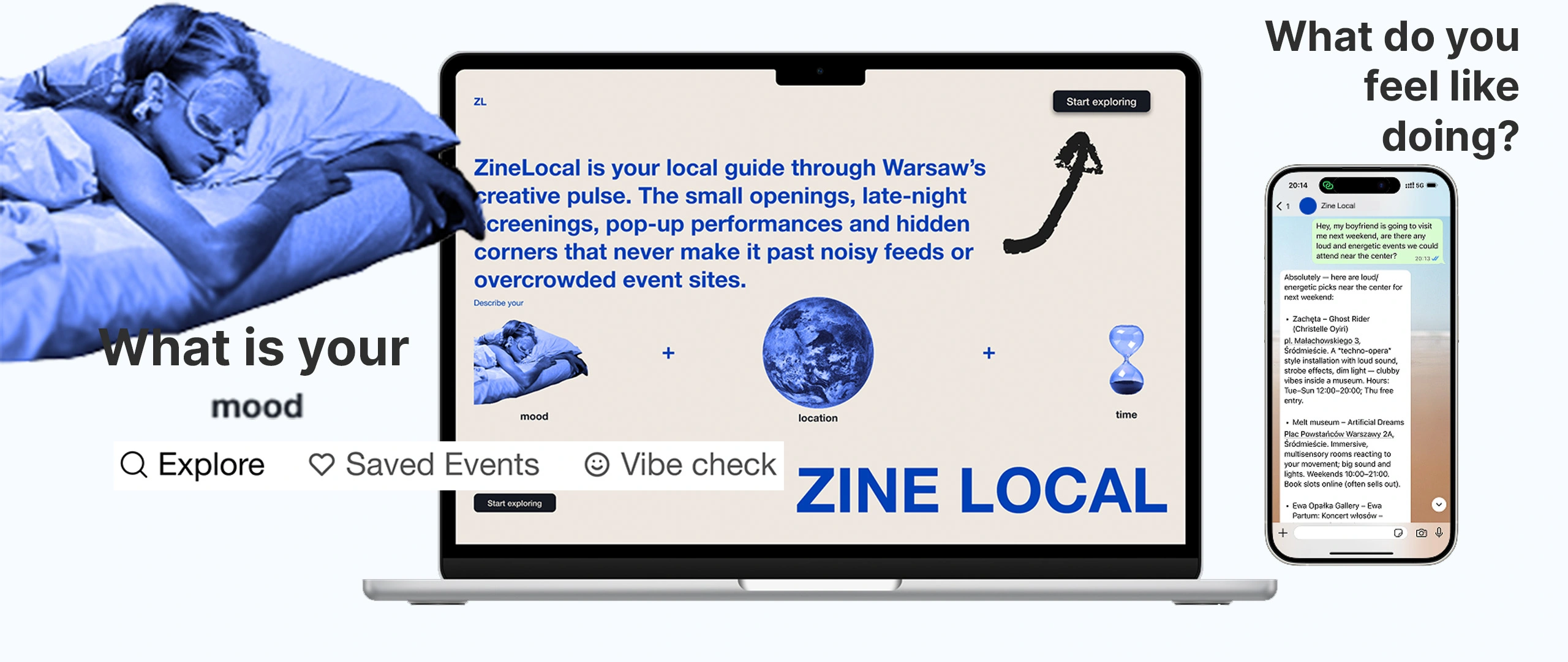
- Role
- Designer, founder and frontend developer
- When
- 2025
- Scope
- UX/UI • Conversational flows • Prototyping
- Tools
- Cursor • Cloudflare • Supabase • Figma
01 Overview
Zine Local was built to solve a real frustration in Warsaw: a rich cultural scene hidden behind scattered Instagram posts and Facebook events
Traditional search fails when you know how you feel but not what to search for.
I designed and prototyped a conversational guide that acts like a knowledgeable local friend — understanding mood, energy and context to suggest events worth attending.

02 The problem
Event platforms overwhelm with noise and fail at emotional relevance
Keyword search doesn’t work when you know how you feel (“quiet and reflective”, “playful and social”) but not what to search for. Discoverers miss meaningful experiences that match their current mood. Local curators and scene insiders have no easy way to share hidden gems.
We needed a system that combines AI’s ability to understand intent with human taste and local knowledge.


03 Mood-first discovery
Zine Local is designed around mood-first discovery rather than traditional filters
The experience supports both quick WhatsApp chats and a clean web interface, lowering friction while maintaining depth. Recommendations are curated and opinionated instead of exhaustive. The architecture is hybrid — WhatsApp plus web — with a foundation for future curator contributions.


| Focus | Research |
|---|---|
| Work | User research and personas for Discoverers and Curators |
| Focus | Conversation |
|---|---|
| Work | Conversational and interface design |
| Focus | Flows |
|---|---|
| Work | Mood-to-recommendation flows |
| Focus | Brand |
|---|---|
| Work | Visual identity and UI |
| Focus | Prototype |
|---|---|
| Work | Functional prototype in Cursor, Cloudflare Workers and Supabase |
| Focus | Access |
|---|---|
| Work | WhatsApp integration |
| Focus | Validation |
|---|---|
| Work | Validation and testing strategy |
| Focus | Work |
|---|---|
| Research | User research and personas for Discoverers and Curators |
| Conversation | Conversational and interface design |
| Flows | Mood-to-recommendation flows |
| Brand | Visual identity and UI |
| Prototype | Functional prototype in Cursor, Cloudflare Workers and Supabase |
| Access | WhatsApp integration |
| Validation | Validation and testing strategy |
04 Design tensions
Mood is fuzzy and changes quickly
Traditional filters assume users know exact genres or venues. Showing too many events feels noisy; too few feels empty. Long-term value also requires input from locals and insiders, not just AI scraping.
| Tension | Mood vs keywords |
|---|---|
| Response | Started with open conversational prompts, then refined with context |
| Tension | Breadth vs authenticity |
|---|---|
| Response | Focused on small, high-quality, opinionated sets per session |
| Tension | Discoverers + curators |
|---|---|
| Response | Designed for easy future curator contributions while prioritizing the discoverer first |
| Tension | Response |
|---|---|
| Mood vs keywords | Started with open conversational prompts, then refined with context |
| Breadth vs authenticity | Focused on small, high-quality, opinionated sets per session |
| Discoverers + curators | Designed for easy future curator contributions while prioritizing the discoverer first |
05 Outcome
A conversational prototype that returns curated lists from preference input
It is a base for exploring vibe-led search as a personal city tool. The project clarified which questions earn useful answers, and where event data quality still limits recommendations.


06 What this taught me
People describe days, not categories
I learned that discovery UX is emotional before it’s informational. The interface has to honor that sequence, not fight it.
If I did it again, I would test with people who deliberately avoid social media, earlier — so edge cases in sourcing and trust show up before polishing UI states.